

 BG
BG DE
DE Hrvatski
 Čeština
 Dansk
Dansk Nederlands
 Eesti
Eesti Suomi
Suomi Français
 Ελληνικά
 Magyar
 Latviešu
 Lietuvių
 Malti
Malti Norsk bokmål
 Polski
 Română
 Slovenčina
 Slovenščina
 Español
 Svenska
 Italiano
 Português, Portugal





























Hexmag magazines have built a genuine following among AR-platform shooters who want a reliable polymer magazine at a fair price point – without settling for something that feels hollow or cheap. The brand sits in a competitive space alongside names like Magpul, but it holds its own with a set of patented features that address real field problems: grip, cleaning access, and round identification. These are not superficial differentiators. They are things that matter when you are running your rifle hard.
Today Hexmag operates under Optimus Arms, having previously been part of the Sentry Products Group. All products are manufactured in the USA. The core design DNA has remained consistent: proprietary polymer, heat-treated stainless steel springs, and that instantly recognizable hexagonal surface pattern pressed into every body.
Brand Story
The brand was founded in 2013 in Loveland, Colorado. The founders looked at what was already on the market and decided they could engineer something better, particularly around the problems that cause magazines to fail: poor follower design, difficult field cleaning, and no quick way to visually identify what caliber or load is in a given mag. From the start, the design process was iterative and hands-on, working through polymer compounds and mold configurations until the feed geometry and lock-up were right. The Hexmag Series 2 followed in 2016, refining the feed lip profile, improving the catch pocket, and adding stripper clip guides. That generation remains the backbone of the current lineup. Sentry acquired the brand in 2017, bringing manufacturing scale and a broader accessories ecosystem with it.
Product Lineup
AR-15 Magazines – 5.56 and .223
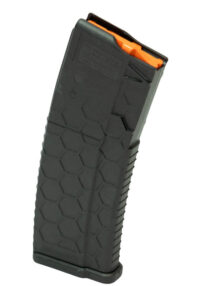
The core of the range is built around the AR-15 platform. The Series 2 is available in 10, 15, and 30-round capacities, all chambered for 5.56x45mm NATO, .223 Remington, and .300 AAC Blackout. The 30-round Hexmag AR-15 mag is the most common choice for range use and training. The 10-round version uses a standard 30-round body with the patented True Riser system internally restricting capacity – relevant for European shooters operating under legal capacity limits. Bodies are constructed from PolyHex2, their proprietary fiber-reinforced composite that resists impact and temperature extremes. The Hexture surface pattern is not decorative: it gives a measurably better grip under wet or gloved conditions. Tool-less baseplate removal means you can strip the magazine for cleaning without any tools at all.
AR-10 Magazines – .308 and 7.62×51
The AR-10 side of the lineup covers .308 Winchester and 7.62x51mm NATO. These hex mags carry the same core design features as the AR-15 series: PolyHex2 construction, heat-treated stainless steel spring, HexID color identification system, and tool-less disassembly. If you are running a .308 semi-auto rifle on a STANAG-compatible lower, this is a straightforward option that does not require any adapter work.
Carbon Fiber Magazines
For shooters who want to reduce carry weight further, Hexmag Carbon Fiber magazines are the premium tier. Carbon fiber magazines in this range are roughly 20% lighter than standard polymer equivalents, with no reduction in structural strength. These are popular with competition shooters where every gram counts across a stage.
Pistol Grips and Accessories
Beyond rifle magazines, the brand offers AR-compatible pistol grips and a range of Hexmag accessories including grip tape inserts and HexID color identification components. The grip tape follows the Hexture pattern and clips directly into the magazine body. The HexID system uses interchangeable colored baseplates and followers to let you differentiate calibers or load types at a glance – genuinely useful when you are running multiple calibers. Hexmag also produces magazines compatible with Glock pistols, carrying the same tool-less design philosophy across to the handgun segment.
Why We Stock Hexmag
We carry Hexmag at No Boring Guns because the demand from European AR and MSR owners is consistent and the product line maps well to what is actually legal and practical here. The 10-round and 15-round capacity options cover the majority of European magazine regulations, and the standard-body format means they fit existing pouches and rigs without modification.
Frequently Asked Questions
Are Hexmag magazines good?
Yes, they have a strong reputation for reliability and are a genuine competitor to the most established polymer magazine brands on the market. The Series 2 design introduced improved feed lip geometry, a revised catch pocket, and stripper clip guides. For AR-15 and AR-10 shooters who want a durable, tool-less, easy-to-maintain magazine at a competitive price point, they consistently deliver.
Where are Hexmags made?
Hexmag products are manufactured in the United States. The brand was originally founded in Loveland, Colorado in 2013, and has since changed ownership twice – most recently coming under Optimus Arms in 2024. Throughout those ownership changes, US-based manufacturing has remained a consistent part of the brand’s identity. All magazines and accessories in the current lineup are American-made.
What is the difference between Hexmag and PMAG?
Both are high-quality polymer AR-platform magazines using impact-resistant composites and stainless steel springs, and both have proven track records. The main practical differences come down to design features: Hexmag’s Hexture surface pattern provides a distinctive grip texture pressed directly into the body, and the HexID color identification system lets shooters differentiate calibers or load types at a glance using interchangeable colored baseplates and followers – something PMAG does not offer natively. Hexmag also uses a fully tool-less baseplate removal system across its range.
32.99€